


Urban Symposium III: City and Memory
Date : 19.10.2026
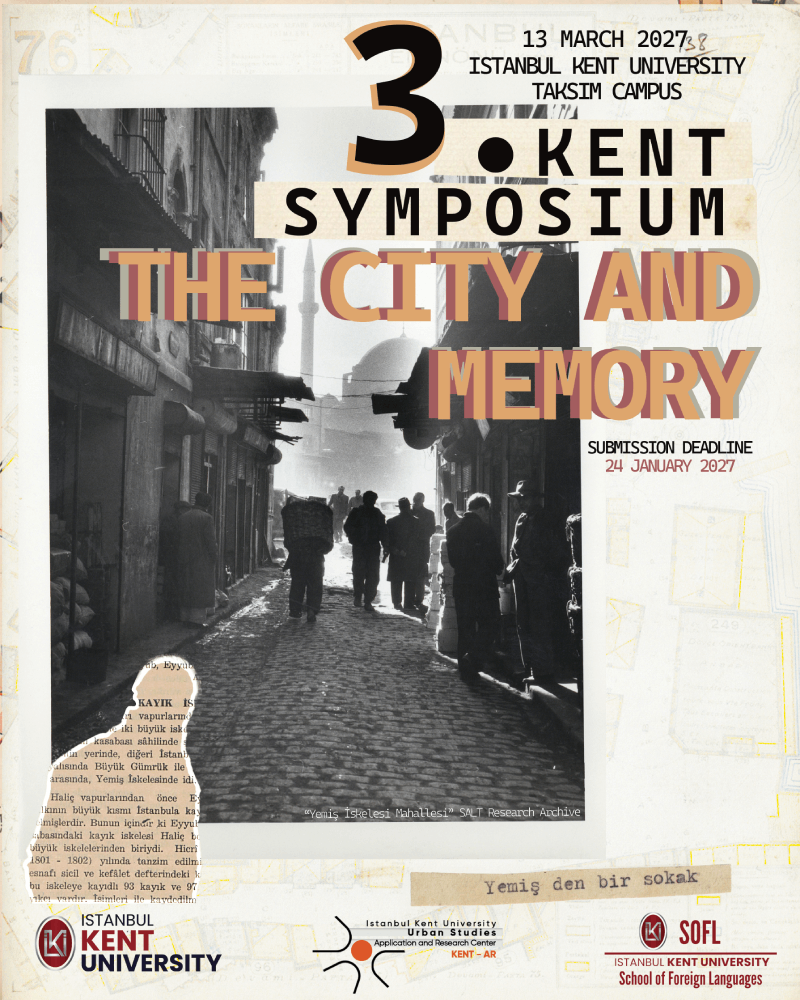
In the place of that magnificent shopping mall we just walked past, there once stood an han or a movie theater. Today, in the area where we park our cars, there used to be a theater building where Afife Jale, one of the first Muslim Turkish women to take the stage, acted with who knows what excitement. Is the sound rising from the street, from Cadde-i Kebir, the hum of the everyday crowd, or is it the voices of women who have been pursuing lost memory and truth for over a thousand weeks? Indeed, this memory that touches the streets and squares shows us how the past integrates with space. Because cities remember and remind through their built environment and also through the memories that societies and individuals enact within these spaces, and through their public spheres. Based on this, the questions of whose words construct urban memory, through which spaces and tools it is built, and which narratives become visible while others are excluded, constitute some of the most fundamental inquiries in urban studies. The urban experiences of women, minorities, workers, and different social groups have not always found equal visibility in historiography; the processes of these groups writing themselves into history and being included in urban memory have faced various difficulties. The changing of street and neighborhood names, the reconstruction of a neighborhood’s history, and the relationship of these narratives with urban transformation or spatial interventions offer a fertile ground for discussing the memory-space nexus. Urban memory can neither be constructed by roads and buildings alone, nor can it be established by societies and individuals independent of space. On the other hand, space is one of the strongest carriers in the intergenerational transmission of memory. Therefore, viewing space as the sole determinant or the subject as merely passive, or conversely, subordinating space and considering the subject as the sole constructor, falls short of explaining this relationship.
In the more than a century since Georg Simmel defined the “blasé” attitude of the metropolitan individual, the city and everyday life have accelerated, and the scale of what falls into our line of sight and our relationship with space has repeatedly changed. Today, opting to “forget” in order to protect oneself from the overstimulation brought about by speed carries the risk of a social amnesia rather than remaining just an individual choice. However, imagining the future of the city entirely independent of the past, or conceptualizing new urban visions completely isolated from memory, damages the social continuity of the city. The question of how the past will be carried to the present and the future through physical spaces directly links memory to the concept of urban conservation, while the effort to tangibly keep the memory of the city alive brings along difficult choices: Which periods’ heritage will be highlighted? Which structures will be deemed worthy of preservation? For instance, is it only the Early Republican or Ottoman structures, or does the civil architecture developed in the 1960s and 70s also form a part of this memory? Just as confining memory to specific spaces and “museifying” it, marketing structures with an aesthetic concern while detaching them from their historical context (“would you like to stay in an old Greek house?”) is among the contemporary practices of forgetting and causing to forget. Moreover, when examining the memory of the city, the reciprocities and permeabilities with the memory of the rural and the provincial must not be ignored.
In this context, where many disciplines such as psychology, sociology, history, political science, urban planning, and architecture intersect, we propose to collectively multiply the following questions or their derivatives at the symposium:
- Through which actors, spaces, and tools is urban memory formed and transmitted?
- What are the continuities and ruptures that constitute urban memory?
- How are the experiences of different social groups (women, minorities, workers, immigrants, etc.) in the city included in memory?
- How do naming practices, urban transformation, and spatial interventions transform urban memory?
- How does the relationship of memory with museification, commodification, and nostalgia shape urban space?
- While architectural and urban conservation policies define certain periods and spaces as heritage, which ones do they leave out of the scope of conservation?
- In what forms and spaces do the searches for reckoning, justice, and truth become visible in the city?
- What are the transitions and reciprocities between urban memory and the memory of the rural and provincial?
In “Urban Symposium III: City and Memory,” we will trace these and similar questions. You can submit your extended abstracts until the deadline of January 24, 2027. For information and any potential issues, you can reach the committee at [email protected]. The symposium will be conducted in a hybrid format (both online and physical) for participants joining from abroad. The language of the symposium, organized by the Istanbul Kent University Urban Studies Application and Research Center (Kent-AR) and the School of Foreign Languages, is Turkish and English.
Discussion Axes and Sub-Themes
The following list is not restrictive but serves as examples to enrich the discussion:
- Historiography, Research Methods, and Urban Narratives: Forgetting, social amnesia, street/neighborhood naming, oral history, archives, the visual and auditory recording of urban memory (cinema, literature, documentary).
- Gender, Queer Memory, and Everyday Life: Care labor, everyday spaces of women, gendered spaces, non-normative urban experiences, the memory of the public sphere.
- Urban Transformation, Destruction, and Spatial Justice: Displacement, adaptive reuse, spatial stigmatization, the right to memory, reckoning, and the search for justice.
- Minorities, Migration, and Borders: Immigration, multi-layered urban memory, spaces of the “other,” traces of communities.
- Labor History and the Memory of Social Movements: The urban experience of the working class, the memory of production spaces, squares, and spaces of urban resistance.
- Conservation Policies, Tourism, and the Commodification of Memory: Architectural conservation, periodization, the physical continuity of buildings, museology practices, gentrification, and nostalgia.
- The City, the Province, and Rural Memory: Transitions between rural history and urban memory, speed and the rhythm of everyday life, ecological memory, the nature-city relationship, and the memory of destruction.
Participation and Application Conditions
Symposium applications are open to researchers, academics, civil society professionals, and anyone producing in related fields who are pursuing or have completed postgraduate studies at the intersection of social and human sciences, architecture, urban planning, art, and design. Since symposium applications are designed for postgraduate researchers and field experts, undergraduate-level applications will not be evaluated. Online presentation opportunities will be provided for participants located abroad. There is no registration or participation fee required for the symposium.
During the application stage, participants are expected to submit the following information completely via the relevant form:
- Name and surname
- Affiliated institution and title (if any)
- Biography (maximum 200 words)
- Extended abstract (must be between 600 and 1000 words in length and include at least 5 keywords)
- Bibliography (Must be added at the end of the abstract and is not included in the 1000-word limit)
Application Form: https://forms.cloud.microsoft/r/s0Jn0wtQXp
Important Dates
- Application Deadline: January 24, 2027
- Announcement of Accepted Papers: February 21, 2027
- Announcement of the Final Program: February 28, 2027
- Symposium Date and Venue: March 13, 2027 / Istanbul Kent University Taksim Campus
Committees
| Board / Committee | Name | Title | University | Department |
|---|---|---|---|---|
| Scientific Committee | Aslı Odman | Asst. Prof. Dr. | Mimar Sinan Fine Arts University | Urban and Regional Planning |
| Scientific Committee | Ayşegül Turan | Asst. Prof. Dr. | Istanbul Kültür University | English Language and Literature |
| Scientific Committee | Burak Onaran | Prof. Dr. | Mimar Sinan Fine Arts University | Sociology |
| Scientific Committee | Deniz Karaca | Asst. Prof. Dr. | Istanbul Kent University | School of Foreign Languages |
| Scientific Committee | Deniz Parlak | Asst. Prof. Dr. | Istanbul Kent University | Political Science |
| Scientific Committee | Ebru Aykut | Assoc. Prof. Dr. | Mimar Sinan Fine Arts University | Sociology |
| Scientific Committee | Feryal Saygılıgil | Prof. Dr. | Independent Researcher | |
| Scientific Committee | G. Pelin Olcay | Asst. Prof. Dr. | Istanbul Kent University | Urban Design and Landscape Architecture / Kent-AR |
| Scientific Committee | Gül Köksal | Assoc. Prof. Dr. | Kocaeli University | Architecture |
| Scientific Committee | Hakan Koçak | Assoc. Prof. Dr. | Independent Researcher | |
| Scientific Committee | Hakan Yücel | Assoc. Prof. Dr. | Galatasaray University | Political Science |
| Scientific Committee | Levent Soysal | Assoc. Prof. Dr. | Independent Researcher | |
| Scientific Committee | Özge Özyılmaz | Assoc. Prof. Dr. | Istanbul Kent University | Radio, Television and Cinema |
| Scientific Committee | Sibel Yardımcı | Prof. Dr. | Mimar Sinan Fine Arts University | Sociology |
| Scientific Committee | Sinem Yıldız | Specialist | Istanbul Kent University | Urban Studies Application and Research Center |
| Scientific Committee | Sonay Ban | Asst. Prof. Dr. | Istanbul Kent University | Visual Communication Design |
| Advisory Board | Aslı Odman | Asst. Prof. Dr. | Mimar Sinan Fine Arts University | Urban and Regional Planning |
| Advisory Board | Asuman Türkün | Prof. Dr. | Yıldız Technical University | Urban and Regional Planning |
| Advisory Board | Ayşegül Turan | Asst. Prof. Dr. | Istanbul Kültür University | English Language and Literature |
| Advisory Board | Burak Onaran | Prof. Dr. | Mimar Sinan Fine Arts University | Sociology |
| Advisory Board | Ceren Lordoğlu | Assoc. Prof. Dr. | Mimar Sinan Fine Arts University | Sociology |
| Advisory Board | Deniz Parlak | Asst. Prof. Dr. | Istanbul Kent University | Political Science and Public Administration |
| Advisory Board | Dicle Koylan | Asst. Prof. Dr. | Istanbul Kent University | Political Science and Public Administration |
| Advisory Board | Ebru Aykut | Assoc. Prof. Dr. | Mimar Sinan Fine Arts University | Sociology |
| Advisory Board | Ergün Şimşek | Lecturer | Istanbul Kent University | Interior Architecture |
| Advisory Board | Ezgi Tuncer | Assoc. Prof. Dr. | Kadir Has University | Architecture |
| Advisory Board | Feryal Saygılıgil | Prof. Dr. | Independent Researcher | |
| Advisory Board | Gül Köksal | Assoc. Prof. Dr. | Kocaeli University | Architecture |
| Advisory Board | Hakan Koçak | Assoc. Prof. Dr. | Independent Researcher | |
| Advisory Board | Hakan Yücel | Assoc. Prof. Dr. | Galatasaray University | Political Science |
| Advisory Board | Jean François Perouse | Faculty Member | University of Toulouse – Jean Jaurès | |
| Advisory Board | Levent Soysal | Assoc. Prof. Dr. | Independent Researcher | |
| Advisory Board | Mehmet Ali Çelikel | Prof. Dr. | Marmara University | English Language and Literature |
| Advisory Board | Nezih Erdoğan | Prof. Dr. | Istinye University | New Media and Communication |
| Advisory Board | Özge Özyılmaz | Assoc. Prof. Dr. | Istanbul Kent University | Radio, Television and Cinema |
| Advisory Board | Sibel Yardımcı | Prof. Dr. | Mimar Sinan Fine Arts University | Sociology |
| Advisory Board | Sonay Ban | Asst. Prof. Dr. | Istanbul Kent University | Visual Communication Design |
| Advisory Board | Umut Azak | Prof. Dr. | Okan University | International Relations |
| Advisory Board | Umut Tümay Arslan | Prof. Dr. | Mimar Sinan Fine Arts University | Sociology |
| Organizing Committee | Deniz Karaca | Asst. Prof. Dr. | Istanbul Kent University | School of Foreign Languages |
| Organizing Committee | Enver Keskin | Lecturer | Istanbul Kent University | School of Foreign Languages |
| Organizing Committee | G. Pelin Olcay | Asst. Prof. Dr. | Istanbul Kent University | Urban Design and Landscape Architecture / Kent-AR |
| Organizing Committee | Selim Burak Yeşildağ | Lecturer | Istanbul Kent University | School of Foreign Languages |
| Organizing Committee | Sinem Yıldız | Specialist | Istanbul Kent University | Urban Studies Application and Research Center |
| Poster Design | Gizem Kepenek | Research Assistant | Istanbul Kent University | Urban Design and Landscape Architecture |